
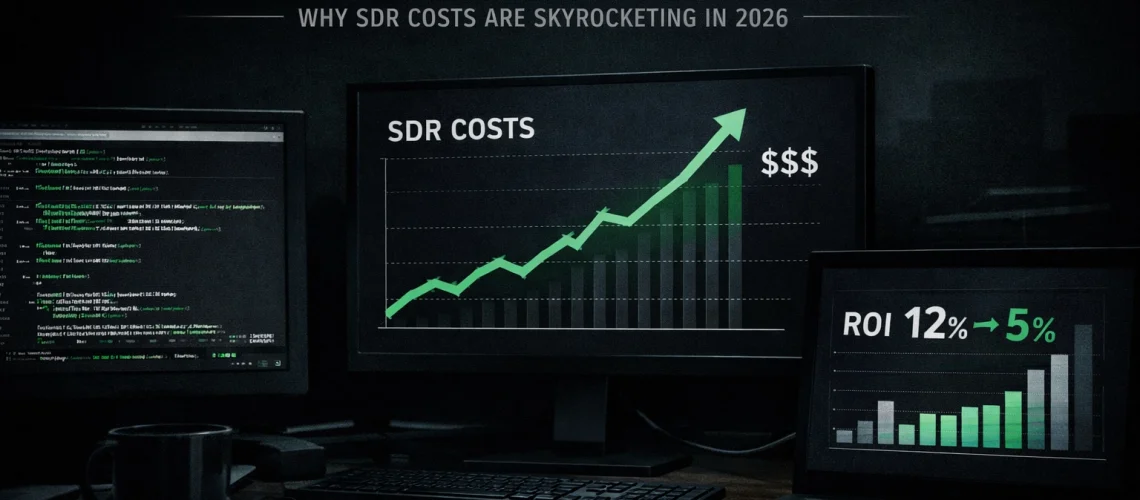
You probably think an SDR costs you $60,000 a year.
That is the number you saw on the job board. It’s the number you put in your financial model when you were pitching your seed round. It’s the number you tell your co-founder when you’re trying to justify why you aren’t doing the outbound yourself anymore.
But that number is a lie.
In 2026, the real cost of a Sales Development Representative has decoupled from reality. Between the base salary, the OTE (On-Target Earnings), the ballooning cost of the sales tech stack, and the invisible tax on your own time, a single SDR is costing your startup upwards of $100,000 to $120,000 a year.
If you’re a pre-seed or seed-stage founder, that is a terrifying amount of burn for a role that has a 50% chance of churning within the first six months. You are essentially gambling a significant portion of your runway on the hope that a 23-year-old with a LinkedIn Premium account can figure out your product-market fit better than you can.
The math doesn't work like it used to. Here is why your outbound is becoming a luxury you can't afford, and how the landscape has shifted in 2026.
The hidden line items in your outbound budget
When we talk about "SDR costs," we usually stop at the paycheck. But hiring a human to do outbound in 2026 is like buying a printer, the machine is the cheap part; it’s the ink and the paper that kill you.
Let’s look at what actually goes into an outbound budget today.
First, there is the Base Salary. In 2026, even in mid-market cities, you’re looking at $55,000 to $65,000. In tech hubs, it’s closer to $75,000.
Then there is the OTE. You have to incentivize them to actually book meetings. Add another $15,000 to $25,000 in commissions.
Then come the Taxes and Benefits. Health insurance, 401k matching, payroll taxes, this usually adds about 20% to 30% on top of the base. We are already at $90,000, and we haven’t even sent a single email yet.

Now, let’s talk about the Tech Stack. This is where founders get blindsided. To be effective in 2026, an SDR needs:
- A data provider (ZoomInfo, Apollo, etc.): $5,000 – $10,000/year.
- LinkedIn Sales Navigator: $1,200/year.
- A sequencing tool: $1,200/year.
- An email deliverability/warmup tool: $600/year.
- AI research tools: $2,000/year.
Suddenly, you are spending $12,000 a year just on the software required for your SDR to sit in their chair.
Finally, there is Ramp Time. It takes three months for an SDR to understand your ICP (Ideal Customer Profile), learn your messaging, and start producing a consistent pipeline. You are paying full price for zero results for at least 90 days. If they quit at month seven, which is common, you’ve spent $50,000 for four months of "actual" work.
Why management time is your most expensive SDR cost
This is the one nobody puts in the spreadsheet, but it’s the one that kills your productivity as a founder.
Hiring an SDR doesn't mean you stop doing sales. It means you become a Sales Manager.
Most founders hire an SDR because they want to "delegate" outbound so they can focus on building the product. In reality, you end up spending 10 to 15 hours a week managing that person. You’re reviewing their drafts. You’re checking their sequences. You’re hopping on 1-on-1s to figure out why their reply rate dropped from 3% to 0.5% overnight.
Your time is the most expensive resource the company has. If you value your time at $200 an hour (which is low for a founder), and you spend 10 hours a week managing an SDR, that’s another $100,000 a year in "hidden" management costs.
You aren't just paying them to work; you're paying yourself to watch them work.
The dream of "set it and forget it" outbound with a human hire is a myth. Humans need coaching, motivation, and constant course correction. When the SDR sends a typo-ridden email to your dream enterprise prospect, you’re the one who has to deal with the brand damage. When they burn your primary domain because they didn't understand technical deliverability, you’re the one spending your Sunday night figuring out how to set up a new workspace.
The "Cheap Outbound is Usually Spam" Objection
Whenever I talk to founders about bringing down outbound costs, they get defensive.
"I don't want to be the guy sending generic 'Hi [First_Name]' emails," they say. "Cheap outbound is just spam. I need a human to do deep research so we don't look like a bot."
They are right about one thing: the era of "spray and pray" is dead. In 2026, email filters are smarter than ever. If you send 500 identical emails, you are going straight to the spam folder. The only way to win today is through hyper-personalization: referencing a specific podcast the prospect was on, a recent funding round, or a specific problem their company is facing.
But here is the dirty secret: most SDRs aren't actually doing that research.
They are tired. They are hitting a quota. They find one "interesting" fact about a company and copy-paste it into 50 different emails. It's "pseudo-personalization." It looks like research, but it lacks the depth required to actually start a conversation.
This is where the paradigm has shifted. You don't need a $100k human to do research anymore. You need a system that can do the research better and faster than a human, but with a "Human-in-the-Loop" to ensure the quality remains high.
The 2026 Reality: The Chicken-and-Egg Problem
For early-stage startups, the SDR model creates a massive "chicken-and-egg" problem.
You need a pipeline to raise your Series A. But you need the money from your Series A to hire the SDRs to build the pipeline. If you spend your remaining seed capital on a couple of SDRs who don't work out, you’ve just shortened your runway and ended your company.
This is why we built Ramen.
We saw too many founders spending $8,000 a month on a single SDR only to get three meetings a month. That’s a $2,600 Cost Per Meeting. It’s unsustainable.
We believe that outbound should cost closer to $499 a month, not $8,000. And it shouldn't be "spam." It should be the exact same level of research you would do if you were writing the email yourself on a Sunday night.
How Ramen flips the script
Ramen isn't a "bot" that blasts emails. It’s an AI SDR platform designed specifically for founders who can't justify a full-time hire but need high-quality outbound.
Here is how it changes the math:
- Deep Research vs. Template Blasting: Instead of just pulling a name from a list, Ramen does deep research on every prospect. It looks at their LinkedIn, their company news, and their recent activity. It finds the "why" behind the outreach.
- Human-in-the-loop: This is the most important part. You don't just turn it on and hope for the best. You approve every single email before it goes out. You get the scale of AI with the quality control of a founder.
- BYOK (Bring Your Own Keys): We don't hide costs behind "credits." You bring your own API keys. You control your own infrastructure. You know exactly where every dollar is going.
- No Ramp Time: You don't need to spend three months training Ramen. You give it your ICP, your product details, and your best-performing angles, and it starts working immediately.

Stop gambling with your runway
The "traditional" SDR model was built for a time when capital was cheap and email filters were dumb. In 2026, neither of those things is true.
If you are a founder, your job is to find the most efficient way to generate revenue. Spending $100k+ on a high-risk human hire before you have a repeatable sales process is not efficient: it's dangerous.
You need a pipeline, but you don't need the overhead. You need research, but you don't need to do it all yourself.
Outbound shouldn't be your biggest expense. It should be your most reliable engine.
If you’re tired of the "SDR carousel" and want to see how you can get 100% research-based outbound for a fraction of the cost of a single hire, see how Ramen works.
Give yourself back your Sundays. Stop being a manager and go back to being a founder.