
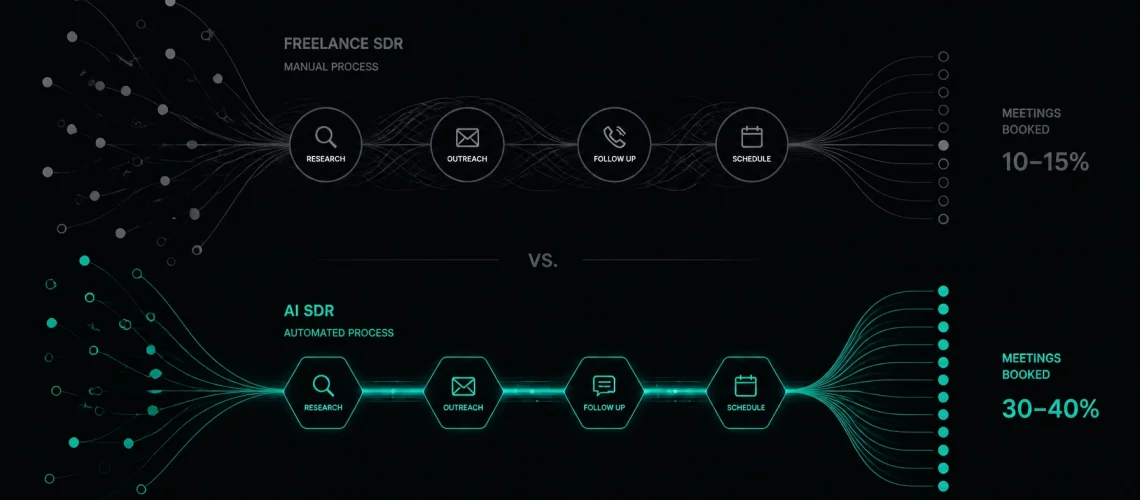
You finally did it. You stopped spending your Sunday nights writing cold emails and hired a freelance SDR. You thought you’d found the shortcut to pipeline growth.
But three weeks in, the reality is hitting your inbox. You’re spending four hours a week rewriting their "personalized" lines because they sound like a generic template. You’re chasing them for status updates on Monday morning. You’re paying for their learning curve, not your growth.
If you feel like you’ve just added "SDR Manager" to your already overflowing plate, you’re not alone. Most founders realize too late that scaling a startup isn't about adding more people: it's about adding more systems.
Why Freelance SDRs Struggle with Scale
Hiring a freelance SDR feels like the right move when you're at the seed stage. You have a little bit of capital, and you need more time. But the math of human-led outbound rarely works for a lean startup.
The first problem is the Management Tax. A freelancer isn't a "set and forget" solution. They need data, they need sequences, and they need constant feedback. If you aren't providing those, they are guessing. And when a freelancer guesses with your brand’s domain, the results are usually expensive and damaging.
Then there is the Consistency Gap. A human SDR can comfortably handle about 50 to 100 personalized touches per day. If they have a doctor's appointment, a bad day, or a slow internet connection, that number drops to zero. In the early days of a startup, your pipeline can’t afford a day off. You need a baseline of activity that happens every single day, regardless of what’s happening in the "real world."
Finally, most freelancers are incentivized by volume or "activity," not necessarily by the quality of the research. This leads to the very thing founders hate: template-blasting. When your SDR sends 500 emails that look like they came from a mail-merge, your reply rates tank and your domain reputation follows.
The Consistency Advantage of AI Agents
This is where the shift toward AI agents becomes undeniable. Unlike a freelancer, an AI agent doesn't have "off days." It doesn't get bored of doing deep research on the 400th prospect of the week.

When we talk about an AI SDR, we aren't talking about a better way to send spam. We’re talking about a system that can do Deep Research at a scale no human could ever match.
At Ramen, our agents don't just pull a name and a title. They look at the prospect’s latest LinkedIn posts, their company’s recent funding rounds, and the specific pain points mentioned in their job postings. They do the work of a top-tier SDR in a fraction of the time.
The result isn't just "more emails." It’s more relevant emails. Because an AI agent can process 1,000 data points in the time it takes a freelancer to grab a coffee, the level of personalization is actually higher. You get the quality of a high-touch human with the volume of a machine.
The Math: $80k Loaded Cost vs. $499/mo
Let’s talk about the numbers, because as a founder, the numbers are what keep you up at night.
A typical in-house SDR has a fully loaded cost of around $80,000 to $120,000 per year once you factor in salary, benefits, and the software stack they need (CRM, data providers, sequencing tools).
A freelance SDR might feel cheaper at $3,000 to $6,000 per month, but you’re still looking at a $40k – $70k annual commitment for part-time work. And that doesn't include the cost of your time spent managing them.
In contrast, an AI agent platform like Ramen starts at $499/month.
When you look at the real SDR costs with simple math, the choice for a seed-stage founder becomes obvious. For the price of a few dinners, you get a 24/7 outbound team that doesn't ask for equity, doesn't need 1:1s, and doesn't quit for a better offer after three months.
"Can I Trust an AI with My Niche?"
This is the number one objection we hear from founders: "My market is too nuanced. AI won't understand the subtle pain points of a Head of Logistics at a mid-market manufacturing firm."
You’re right to be skeptical. If you use a generic AI tool to write your emails, it will fail. It will sound like ChatGPT wrote it: polite, wordy, and ultimately useless.

That’s why the Human-in-the-Loop model is the only way to scale outbound without ruining your brand. With Ramen, you aren't turning over the keys to a robot and hoping for the best.
Our agents do the heavy lifting: the data scraping, the lead list building, the initial drafting based on deep research: but you approve every single email before it sends.
This gives you the best of both worlds. You get the scale of AI, but the quality control of your own founder-level expertise. You can see how we handle human-in-the-loop AI SDRs to ensure your brand reputation stays intact while your pipeline grows.
Building a Pipeline You Can Actually Scale
Scaling isn't about working harder; it's about removing yourself as the bottleneck.
If you are a solo founder or leading a small team, your time should be spent closing deals and building product, not manually hunting for leads or managing a freelancer who isn't hitting their numbers.

The transition from manual outbound to an AI-led process usually follows a simple path:
- Define your ICP: Use your existing knowledge to tell the AI who your best customers are.
- Deep Research: Let the AI agent scrape the web to find the "why now" for every prospect.
- Approve and Send: Spend 15 minutes a morning reviewing drafts instead of 4 hours a night writing them.
- Iterate: Use the reply data to refine your messaging.
By moving to an AI-driven model, you’re not just saving money; you’re buying back your Sundays. You’re creating a predictable, scalable machine that generates meetings while you sleep.
The Choice for Seed-Stage Founders
You have two options for your outbound strategy this quarter.
You can hire another freelancer, spend two weeks onboarding them, and then spend the next three months wondering why they aren't booking more demos. You'll deal with the "ramp-up period," the management overhead, and the inconsistent results.
Or, you can deploy a team of AI agents that are ready to work today.
At Ramen, we built our platform for the founder who knows outbound works but doesn't have the time to do it themselves. We give you unlimited configurable AI agents for a flat monthly fee, and you bring your own API keys to keep costs completely transparent.
The days of $80k SDR hires for early-stage startups are over. The future of scaling is lean, automated, and research-first.
Stop being the bottleneck in your own sales process. See how Ramen can scale your outbound without the management headache.