
You finally hit that milestone. Maybe it was a seed round, or maybe you just closed your third enterprise pilot by yourself. You’re tired of spending every Sunday night hunched over a spreadsheet, manual-typing "I saw your LinkedIn post about…" into fifty different cold emails.
The obvious move is to hire a Sales Development Representative (SDR). You look at the market rate, see a $65k base salary, and think, "I can afford that."
But the $65k is a lie.
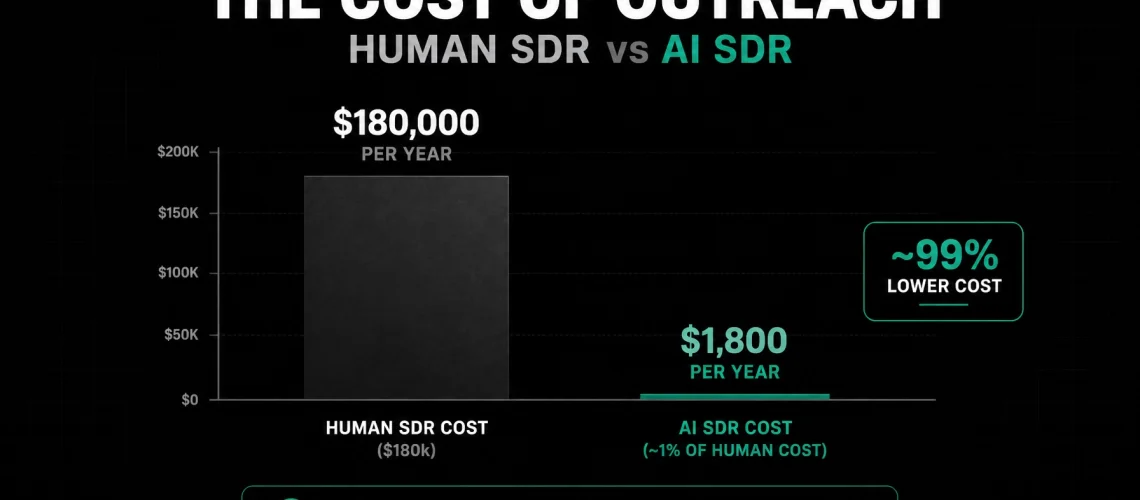
By the time you factor in recruitment fees, the three-month "ramp" where they produce nothing, the massive tech stack they require, and the high probability they’ll quit the moment they're actually trained, that "affordable" hire is costing you closer to $180,000 in its first year.
For a pre-seed or seed-stage founder, that’s a gamble that can kill your runway before you even find product-market fit. I’m going to show you exactly where that money goes: and why a $499 AI agent is no longer just a "cheaper" option, but the only way to scale outbound without the overhead that sinks most early-stage startups.
Beyond the Salary: The True SDR Costs
When you hire a human SDR, the salary is just the entry fee. In 2026, the "fully loaded" cost of an employee is higher than ever. If you aren't calculating the following four buckets, you're underestimating your burn by at least 40%.
1. The Recruiting Tax
Most founders don't have time to sift through 400 entry-level resumes. You hire an agency. Standard recruitment fees for sales roles sit around 20-25% of the first-year OTE (On-Target Earnings). If your SDR's target is $85k, you’re cutting a check for $17,000 before they’ve even sent their first email.
2. The Tech Stack Overhead
A human SDR is only as good as their tools. They’ll tell you they need LinkedIn Sales Navigator ($150/mo), a CRM seat ($100/mo), a sales engagement platform like Apollo or Outreach ($100/mo), and a data provider like ZoomInfo ($300/mo).
Before they've even written a subject line, you’re paying $6,000 to $10,000 per year just to keep their terminal open.
3. Benefits and Payroll Taxes
Healthcare, dental, 401k matching, and employer-side payroll taxes typically add another 25% to the base salary. On a $60k base, that’s another $15,000 out of your bank account.
4. Management "Mindshare"
This is the cost no one puts in a spreadsheet. You aren't just paying them; you’re managing them. You’re reviewing their scripts, doing 1-on-1s, and checking their activity levels. For a founder, your time is valued at hundreds of dollars an hour. If you spend five hours a week managing one SDR, you’re "spending" another $20,000+ a year in lost opportunity cost.
When you add it all up, that $60k hire quickly balloons into a $130k-$180k annual commitment.

The Productivity Gap: Why SDRs Are a Leaky Bucket
Even if you have the cash, there’s a fundamental problem with the human SDR model in early-stage startups: The Ramp and The Exit.
It takes an average of three to four months for a new SDR to become "fully ramped." During those first 90 days, you are paying 100% of the costs for maybe 20% of the output. You are essentially subsidizing their education on your dime.
And here’s the kicker: the average tenure for an SDR in tech is roughly 15 months. By the time they are finally good at their job, they are looking to get promoted to Account Executive (AE) or they’re getting poached by a Series B company that can pay them $20k more.
You spend $180k to get 9 months of peak productivity, then you have to start the cycle all over again. It’s a treadmill that never stops, and it’s why so many founders feel like outbound "doesn't work": it’s not the outbound that’s broken, it’s the unit economics of the person doing it.
Why Startups are Pivoting to AI for Outbound
This is where the math shifts. In 2026, the AI-SDR vs. Human SDR debate isn't about "replacing people": it's about basic survival for startups.
The logic is simple: If you can get 90% of the results of a human SDR for 5% of the cost, you’d be negligent not to do it. But it's not just about the $499/month price tag. It’s about three specific advantages that AI has over any entry-level hire:
- Unlimited Scale: A human SDR can realistically send 50 high-quality, personalized emails a day. An AI agent can send 500. It doesn't get tired, it doesn't need "mental health days," and it doesn't get bored of researching prospects.
- Instant Ramp: There is no 3-month waiting period. You plug in your ICP (Ideal Customer Profile), connect your data, and the agent is live.
- Zero Turnover: Your AI agent doesn't quit to go find a "better opportunity" just when it starts booking meetings. It stays with the company, getting smarter with every response it receives.

Objection Handling: "But Can AI Really Research Like I Do?"
The biggest hesitation founders have is quality. "I’ve seen AI emails," they say. "They’re generic, they use words like 'leverage' and 'tapestry,' and they’re obvious spam."
They aren't wrong. Most "AI outbound" tools are just GPT-4 wrappers that look at a LinkedIn headline and call it "personalization." That’s not what we’re talking about here.
At Ramen, we built a research-first AI SDR. Our agents don't just "read" a profile; they perform a deep-dive on every prospect. They look at:
- Recent podcast appearances or interviews.
- Company financial reports and news.
- Specific pain points mentioned in LinkedIn posts.
- The exact technology stack the company is using.
The result isn't a template with a "Hello {Name}" tag. It’s a highly specific, context-rich email that looks like it was written by a founder who actually did their homework.
The second objection is the "Black Box" fear. You don't want an AI agent going rogue and burning your domain reputation by sending garbage to your best prospects.
This is why we champion the human-in-the-loop approach. You (the founder) approve every single email before it goes out. You get the scale of AI with the editorial control of a human. You spend 15 minutes a day reviewing a queue of perfect drafts instead of 15 hours a week writing them from scratch.
The $499 Decision: Cost Control via BYOK
Most AI platforms charge you per lead or per email sent. They want to be another "tax" on your growth.
We took a different route. At Ramen, we use a BYOK (Bring Your Own Keys) model. You pay us a flat $499/month for the platform and the unlimited agents. You provide your own AI API keys (like OpenAI or Anthropic).
This gives you complete cost control. You pay the raw cost of the tokens you use. No markups, no hidden "platform fees" per lead, and no being held hostage by a pricing model that punishes you for succeeding.

Stop Wasting Your Sundays
The "Hidden Costs" of a human SDR are more than just financial. They are emotional. Every hour you spend recruiting, training, and managing a junior salesperson is an hour you aren't spending on your product or your customers.
In the early days, you are the best salesperson your company will ever have. You have the most context, the most passion, and the best "gut feeling" for what resonates. But you shouldn't be the bottleneck for sending the emails.
Ramen lets you clone your expertise. Our agents do the heavy lifting: the research, the drafting, the follow-ups: and you provide the final "Yes" that keeps your brand's quality high.
If you’re ready to get your Sundays back and build a pipeline that doesn't cost $180k a year to maintain, see how it works at Ramen.so.