
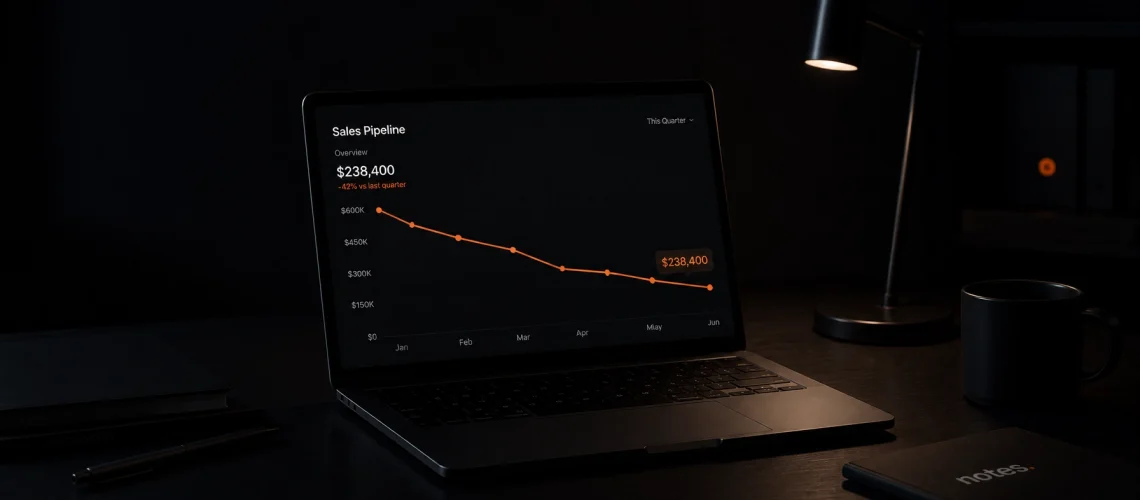
You thought a contract SDR would be the "safe" middle ground.
You weren't ready to drop $120,000 on a full-time hire with a 4-month ramp time, but you also didn't have 20 hours every weekend to research prospects and manually write emails. So, you hired a freelancer. No benefits, no long-term commitment, just a "pro" to keep the engine running while you build the product.
But three months in, the reality is setting in. The "pipeline" they promised is mostly just a spreadsheet of names you already knew. Your reply rates are hovering around 1%, and half of those are "unsubscribe" requests. Worst of all, your Slack messages to them are going unanswered for 48 hours at a time.
You're being ghosted. Not just by the prospects, but by the person you hired to find them.
The truth is that quality prospecting requires a level of deep research and consistent attention that most contract SDRs simply can’t: or won’t: give you. Here are the five reasons why your freelance experiment is failing, and why the "middle ground" is actually the most dangerous place to be.
1. The Freelancer’s Divided Attention
When you hire a contract SDR, you aren't hiring a team member. You’re hiring a service provider who is likely juggling four or five other clients just like you.

Think about the math. If they are charging you $3,000 a month, they need five clients to make a decent living after taxes and tool costs. That means you are getting exactly 20% of their brainpower.
When one of their other clients has a "fire" or offers them a bigger contract, your pipeline is the first thing that gets deprioritized. They aren't thinking about your ICP (Ideal Customer Profile) while they shower. They aren't staying up late wondering why your last campaign flopped. They are just trying to hit their minimum activity metrics so they can send you an invoice at the end of the month.
In the world of outbound, 20% effort equals 0% results. Prospecting is a momentum game; the moment the focus shifts, the pipeline dries up.
2. Templates vs. Deep Research
Most contract SDRs use a "spray and pray" playbook because it’s the only way they can remain profitable.
Deep research takes time. To find a prospect's recent podcast appearance, read their latest 10-K, or understand a specific technical challenge their engineering team is facing takes at least 15–20 minutes per lead. If a contractor is working for five clients, they physically do not have the hours in the day to do this.
Instead, they rely on templates. They’ll use a generic "I saw you're the VP of Engineering at [Company]" opener and hope for the best.
The problem? In 2026, your prospects' inboxes are more crowded than ever. A template isn't just "less effective": it’s a signal to your dream accounts that you don't value their time. When a freelancer burns through your list of "Top 100 Must-Win Accounts" with a generic sequence, they aren't just failing to book a meeting. They are actively closing doors that might stay shut for years.
3. They Are Burning Your Domain Reputation
This is the hidden cost that keeps founders up at night.
A contract SDR is often incentivized by volume or "leads," not by the long-term health of your company. To hit their numbers, they might push the limits of your email sending volume or use lead lists that haven't been properly cleaned.
If they trigger spam filters or get your domain blacklisted, they can just move on to their next client. You, however, are left with a burned domain that can take months to fix. We've seen solo founders who had to completely change their company URL because a "cheap" contractor sent 500 unpersonalized emails a day from their primary workspace.
Outbound is a surgical tool. When you hand it to someone who is rushing to finish their tasks for the day, they treat it like a sledgehammer.
4. The "Ghosting" Cycle
Have you noticed that the contractor is most active in the first two weeks, and then slowly disappears?
This is the Ghosting Cycle. It happens because outbound is hard. When the initial "easy" leads are exhausted and the hard work of iterating on messaging begins, many freelancers lose interest.
Because they aren't embedded in your company, they don't feel the pressure of the upcoming board meeting or the dwindling runway. If the campaign isn't working, it’s easier for them to stop responding to your messages and focus on a "fresh" client where they can run their honeymoon phase again.
You’re left holding a stalled engine, having lost three months of time that you’ll never get back. For a seed-stage startup, three months is an eternity.
5. The Cost-to-Value Mismatch
Let’s look at the simple math of a human SDR vs. the outcomes you actually need.
A mid-market contract SDR in 2026 costs between $4,000 and $7,000 per month. When you add in the cost of their tech stack: Apollo, LinkedIn Sales Navigator, Clay, and email warm-up tools: you’re easily looking at $8,000+ per month.
If they book you two qualified meetings a month (a common average for struggling contractors), you are paying $4,000 per meeting.
That is an unsustainable CAC (Customer Acquisition Cost) for almost any startup. You’re paying for a human’s time, not for the results. You’re essentially subsidizing their learning curve and their other clients' campaigns.
"But Don’t I Need a Human for the Nuance?"
This is the most common objection we hear. Founders think that only a human can understand the "subtle nuances" of their industry.
The reality is that a distracted human is far less "nuanced" than a dedicated AI agent. While your contractor is skimming a LinkedIn profile for three seconds, an AI agent like Ramen is performing deep research across every corner of the internet.

Ramen doesn't just look at a job title. It reads the prospect’s recent tweets, their company’s latest press releases, and even the technologies they’re currently hiring for. It then uses that data to write a 1-to-1 personalized email that feels like it was written by a founder, not a bot.
And because we believe in human-in-the-loop, you still get the nuance. You approve every single email before it goes out. You get the quality of a world-class SDR with the scale and cost-control of AI.
The Bridge to a Better Pipeline
You don't need a contract SDR. You need a prospecting engine that doesn't get bored, doesn't juggle other clients, and doesn't charge you $80,000 a year for template-level work.
At Ramen, we built the platform we wanted as founders. We provide you with unlimited configurable AI agents for $499/month. You bring your own API keys, so you have full control over your costs and your data.
Stop spending your weekends wondering why your contractor hasn't replied to your Slack. Start building a pipeline that actually scales.